What is the best app to track intermittent fasting?
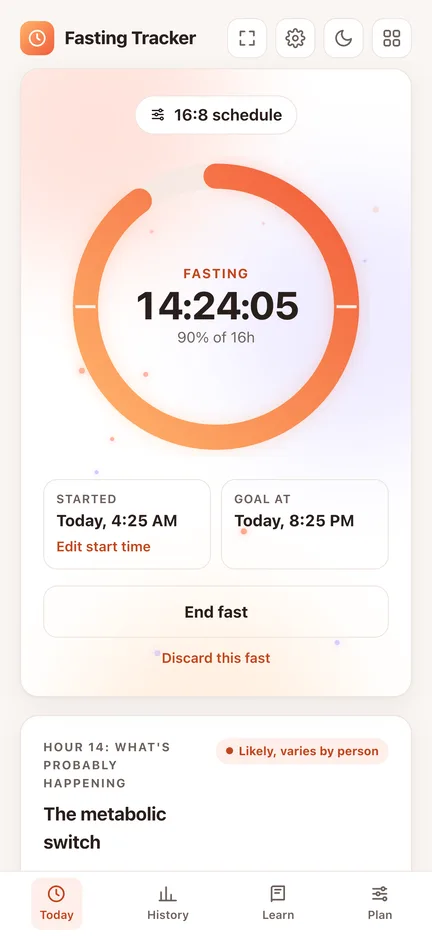
One that shows clearly how long you have fasted, lets you fix mistakes and does not oversell the science. Fasting Tracker has a live timer for common schedules, an hour-by-hour guide with sources and certainty labels, and a history you can export.
Which fasting schedules can I use?
12:12, 14:10, 16:8, 18:6, 20:4 and OMAD (23:1), or any custom length from 12 to 23 hours. 24-hour and 36-hour fasts are available too, with a reminder to check with a doctor first. The short quiz in the Plan tab suggests a gentle schedule.
What happens to your body during a 16 hour fast?
In the first hours you digest your last meal, then the body runs on stored sugar. Somewhere beyond about 12 hours many people start using more fat and making small amounts of ketones, but when it happens depends on your last meal and how active you were. The app explains each step and how certain the research is.
Does autophagy start at 16 hours?
That claim is popular but not proven in people. The app labels it as a myth and explains what is actually known.
I forgot to start the timer. Can I fix it?
Yes. You can set the start time of the current fast, edit any logged fast and add a past fast you forgot to log.
Will I get notifications when my fast is over?
The app can show a browser notification when you reach your goal and remind you to drink water, as long as the app is open in a browser tab. It cannot send push notifications while it is closed.
Where is my data stored?
Only on your device, in your browser. Nothing is uploaded. You can export a PDF report, a CSV file or a full backup at any time.
Is Fasting Tracker medical advice?
No. It is a timer and an educational guide. Fasting is not suitable for everyone. Check with a doctor first if you have diabetes, take medication, are pregnant or breastfeeding, or have a history of eating disorders, and stop and seek help if you feel unwell.
Where do the health explanations come from?
From peer-reviewed research and major medical sources, such as the New England Journal of Medicine, Obesity and Johns Hopkins Medicine. Each explanation links to its sources.