

A 1-minute listening game
How old are your ears?
Put on headphones and climb a ladder of high beeps, from 12,000 Hz up to 20,000 Hz. The highest one you still hear gives your ear age, and your real age turns it into a score: how many years younger than you your ears are. Then send the link to your friends, your partner or your parents, and see whose ears are better kept.
- ✅ Free, no sign-up
- 🎧 Real tones, live in your headphones
- 📏 Your ears vs your age
- 🏆 Challenge links + scoreboard
- 🌍 7 languages
Just for fun, not a hearing test.
Most teenagers still hear tones near 20,000 Hz. By 30, most people top out around 16,800 Hz, by 40 around 14,900 Hz and by 50 around 13,300 Hz. Your headphones and volume change it, and people of the same age vary a lot.
Why the videos lie
“Can you hear this?” videos can't tell your age
TikTok, Instagram, YouTube and WhatsApp squeeze their audio and cut most sound above about 16,000 Hz. By the time the famous mosquito clip reaches your phone, the top tones are often gone, so everybody "fails" or the clip just plays a click. The game makes its tones live in your browser and sends them straight to your headphones.
Play nowSame tone, four ages
Same ears. Four ages.
One sweep from 8,000 to 20,000 Hz. Each wave stops where a typical ear of that age stops hearing. Where does yours stop?
 18🔇 stops at 20,000 Hz
 30🔇 stops at 16,800 Hz
 45🔇 stops at 14,100 Hz
 60🔇 stops at 11,300 Hz
Typical (median) limits for each age from the hearing studies behind the game; people of the same age vary by thousands of hertz. Portraits: AI illustration of one person at four ages.
How it plays
One minute, three steps
No microphone, nothing to install, on a phone or a computer. Headphones on, volume set once, and climb.
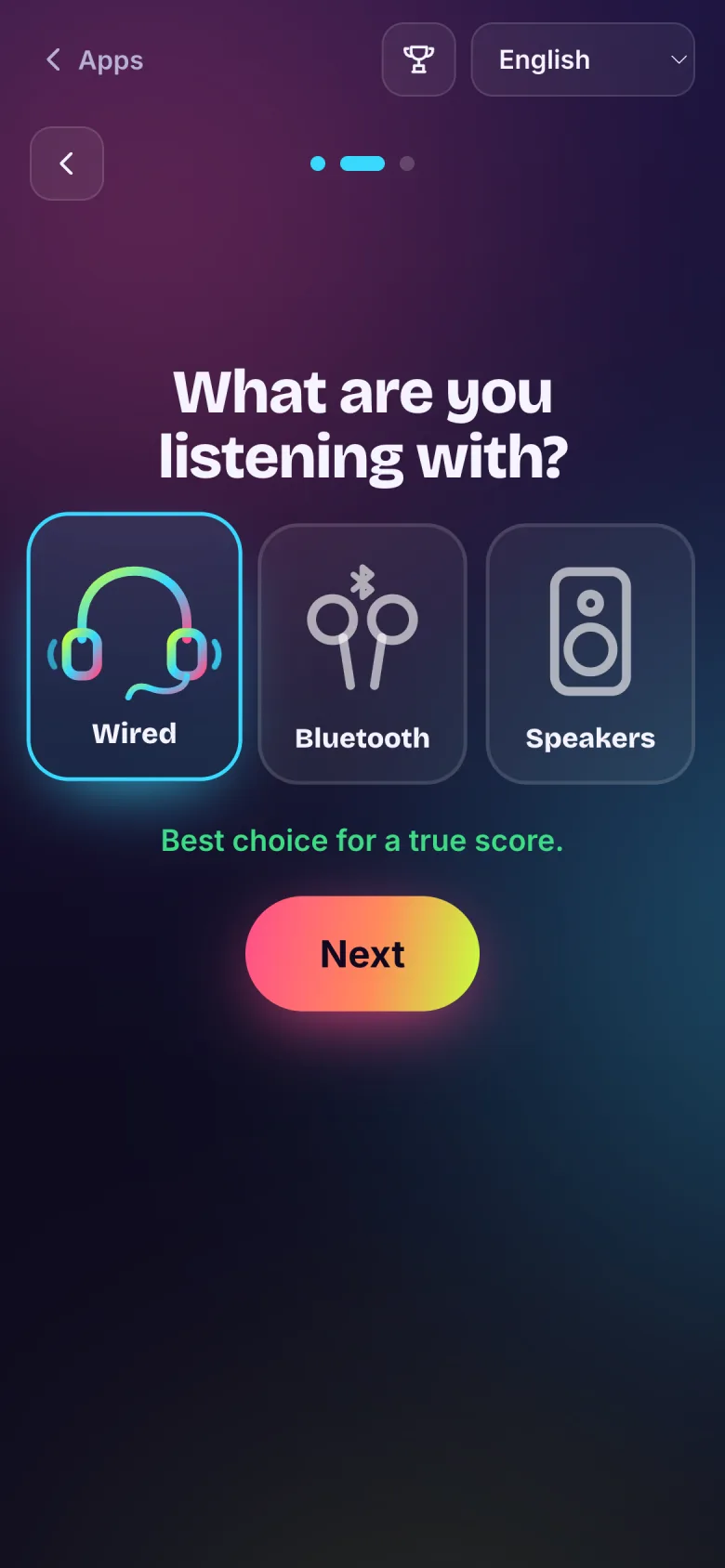
1Headphones on
Type your age, pick what you are listening with and set your volume on one comfortable tone. Then leave it there.
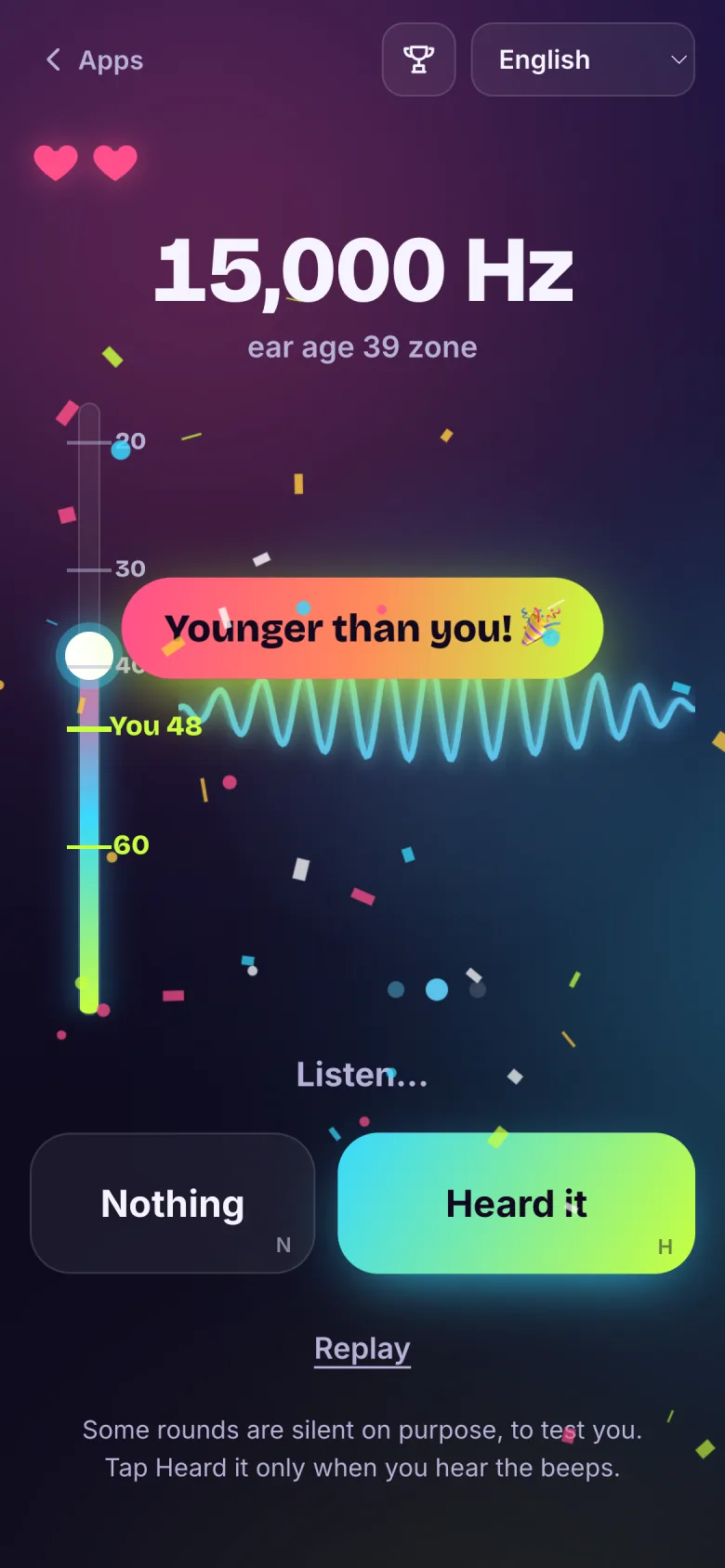
2Climb the ladder
The beeps climb higher and higher. Tap Heard it when you hear them, Nothing when you don't. Some rounds are silent on purpose, to test you. Pass the ages on the way up.
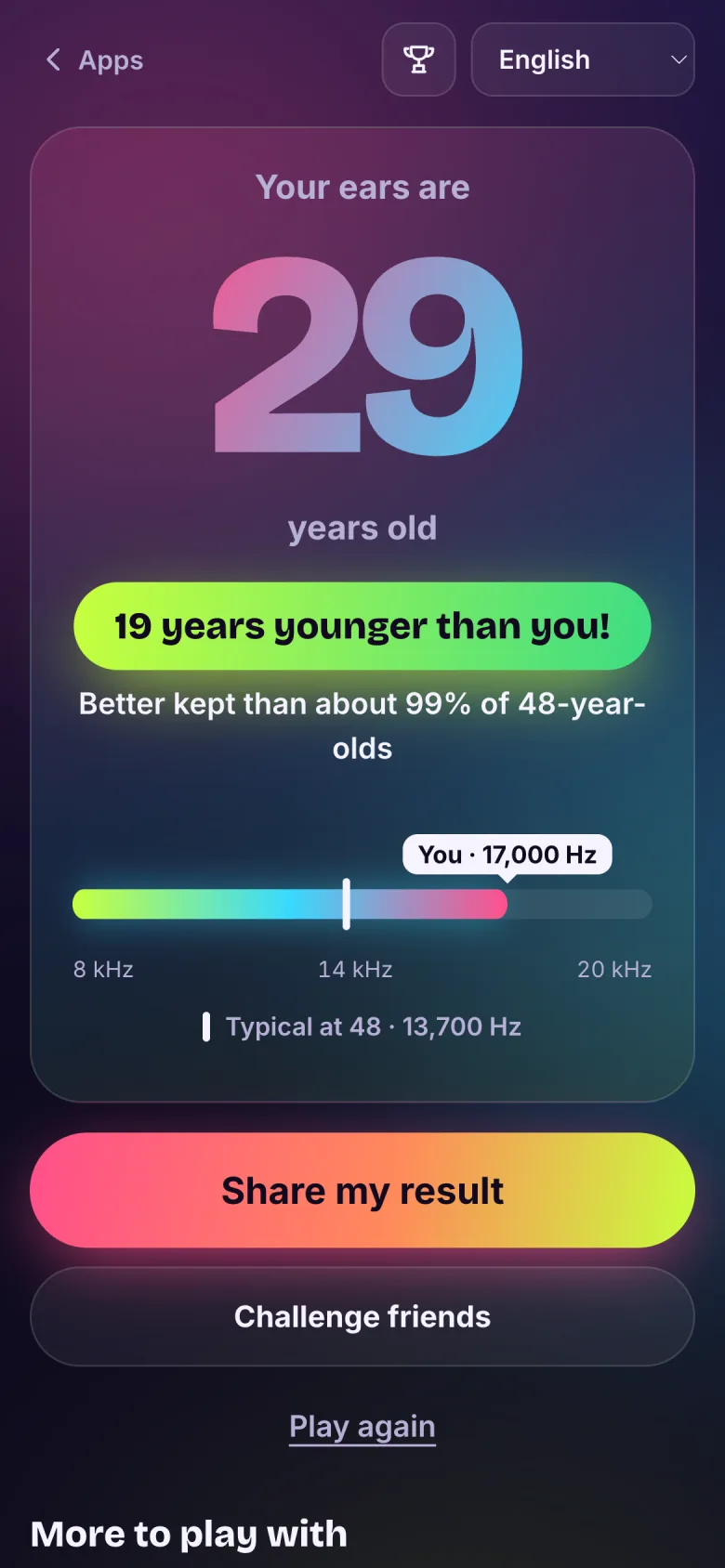
3Get your ear age
Your highest tone becomes an ear age, from “under 18” to “60+”, and a score: how many years younger than you your ears are.
Hearing age by frequency
What can you hear at your age?
The table is the one the game uses: for each tone, the typical (median) age of people who still hear it at a comfortable level. It comes from published studies of high-frequency hearing, and it is capped at “under 18” and “60+” because the data gets thin at both ends.
| Highest tone heard | Ladder | Ear age |
|---|---|---|
| 20,000 Hz | <18 | |
| 19,500 Hz | 19 | |
| 19,000 Hz | 21 | |
| 18,500 Hz | 23 | |
| 18,000 Hz | 25 | |
| 17,500 Hz | 27 | |
| 17,000 Hz | 29 | |
| 16,500 Hz | 31 | |
| 16,000 Hz | 33 | |
| 15,500 Hz | 36 | |
| 15,000 Hz | 39 | |
| 14,000 Hz | 46 | |
| 13,000 Hz | 52 | |
| 12,000 Hz | 58 | |
| 11,000 Hz | 60+ | |
| 10,000 Hz | 60+ |
The famous “mosquito” tone (17,400 Hz) sits between 17,000 and 17,500 Hz: a typical ear age in the late twenties, not a hard line at 25.
The score that matters
48 years old. 29-year-old ears.
Teenagers top out near the top of the ladder; that's expected. The fun is the gap: the game turns your top tone and your real age into how many years younger than you your ears are, and how they compare with other people your age. A 48-year-old who still hears 17,000 Hz has ears about 19 years younger, better kept than almost everyone their age.
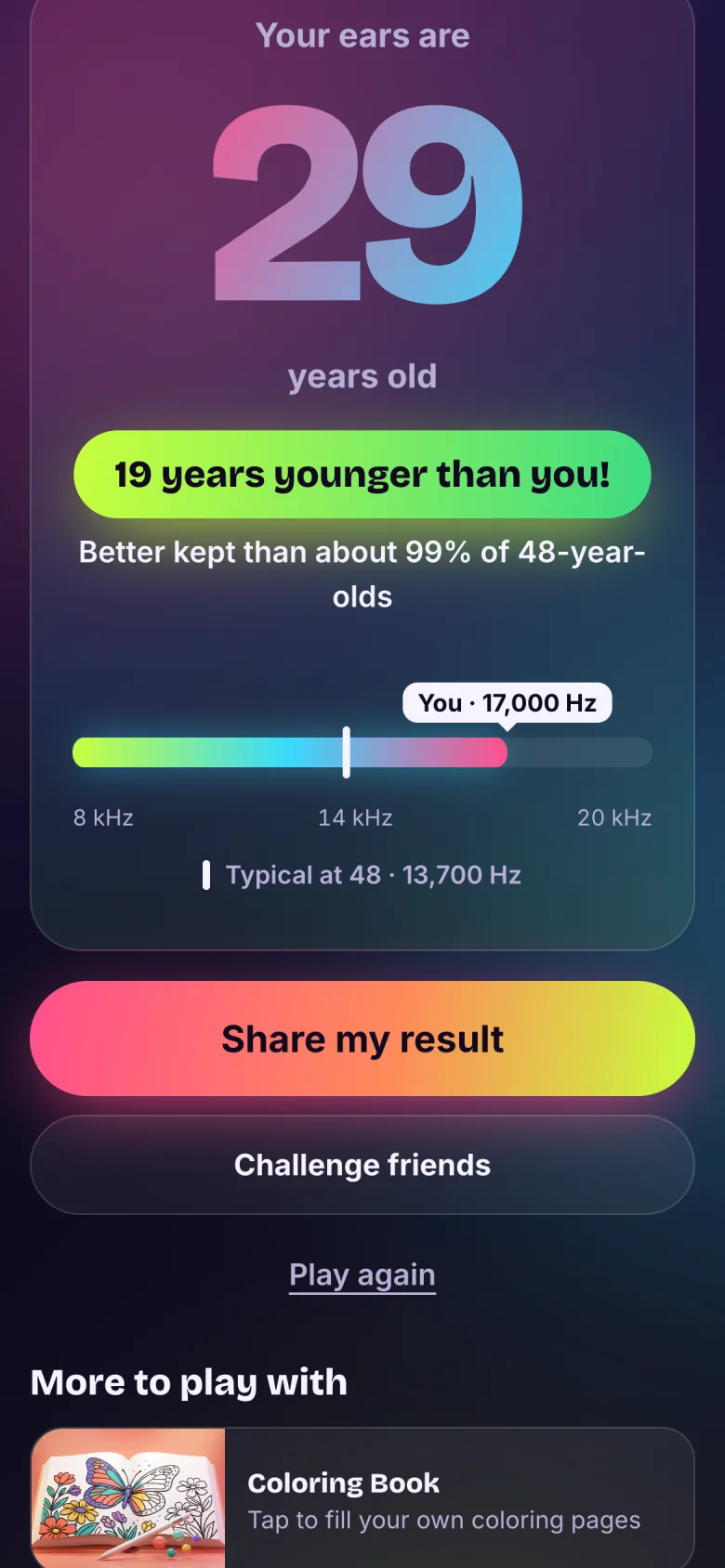
Bring the family
Your kids hear 19,000 Hz. Do you?
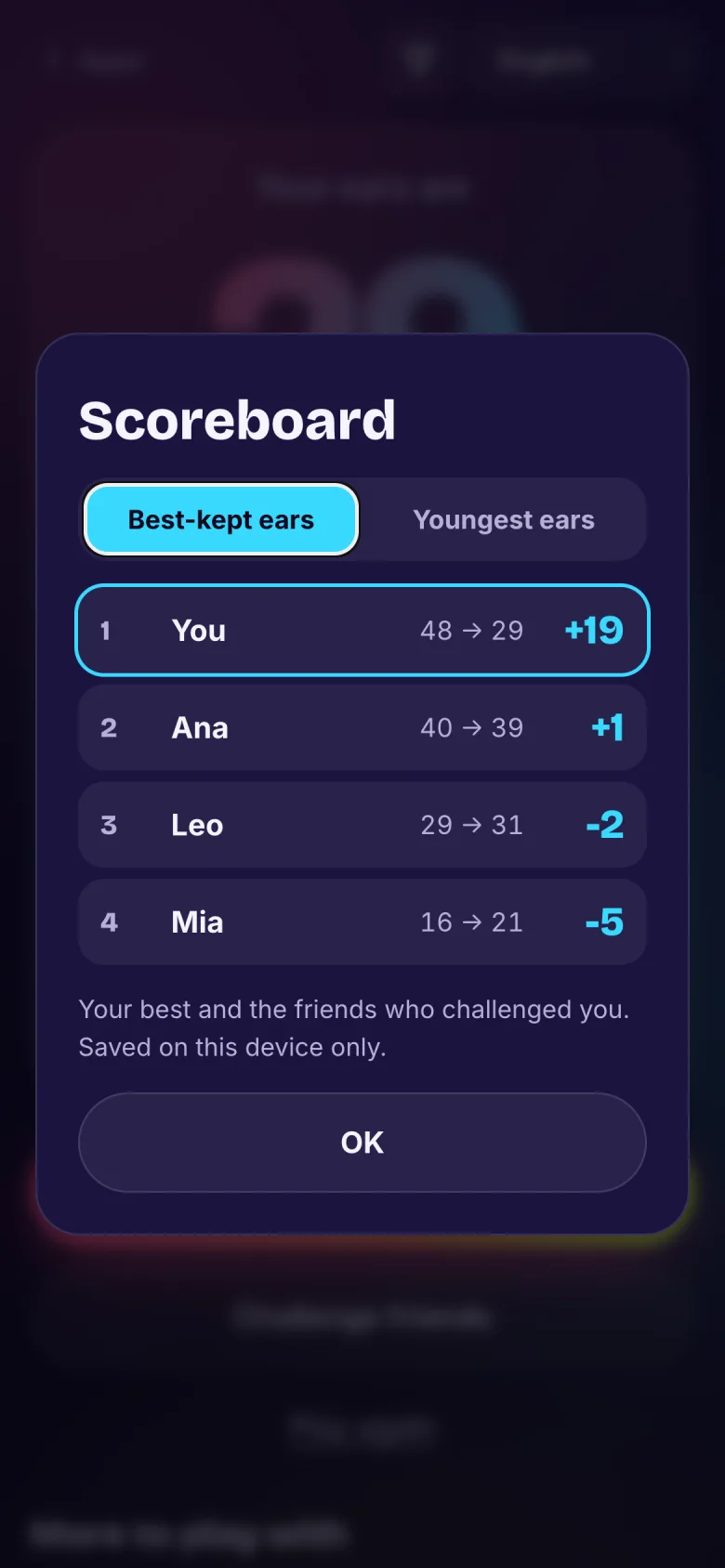
Send a challenge link with your score and your age. Your friends, partner or parents open it, see your ear age and play the same ladder. Then the scoreboard ranks the best-kept ears and the youngest ears, and the story-size card shows your badge and your range bar.
Play now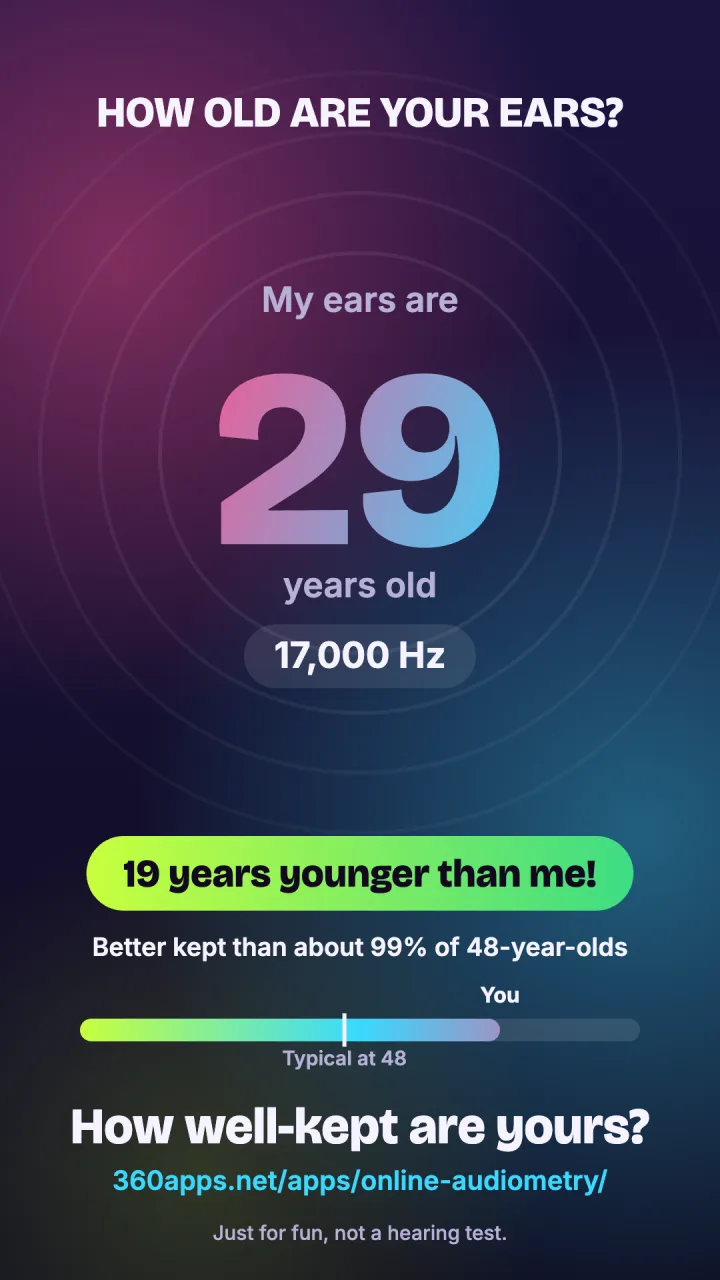
The honest part
Why your ears have an age
High tones go first
The hair cells that pick up the highest pitches sit at the entrance of the inner ear and wear out first. That is why the top of your range drops, slowly, from your late teens on. Noise speeds it up.
Where the ages come from
Hearing studies measured the quietest high tone people of each age can hear. The game turns that into “about half of people this age still hear this tone at a comfortable volume”.
What changes your score
Headphones, Bluetooth, your volume and a noisy room all move the result by a few “ear years”. That is why it is a game and not a hearing test. Worried about your hearing? See an audiologist.
Sources behind the table: Ashihara (2007), J Acoust Soc Am 122:EL52 · Rodríguez Valiente et al. (2014), Int J Audiol 53:531 · Wang et al. (2021), J Otolaryngol Head Neck Surg 50:52 · Škerková et al. (2022), Eur Arch Otorhinolaryngol 280:565 · Leighton (2016), Proc R Soc A 472:20150624.
Questions people ask
How old are your ears?
Your ears have an "age" because the highest pitch people can hear drops as they get older. Most teenagers still hear tones near 20,000 Hz; by 30 most people top out around 17,000 Hz and by 50 around 13,000 Hz. The game finds the highest tone you hear in your headphones and shows the typical age of people who hear up to that pitch.
How does the ear age game work?
You type your age, set your volume on one comfortable 1,000 Hz tone, then climb a ladder of short beeps that starts at 12,000 Hz and goes up to 20,000 Hz. Tap Heard it or Nothing after each round. When a tone is out of reach, the climb stops and your highest tone becomes your ear age, from "under 18" to "60+", with how many years younger (or older) than you your ears are.
What does "better kept than X% of people my age" mean?
People of the same age spread widely: some hear thousands of hertz higher than others. The game compares your ear age with the typical spread for your real age, from published hearing studies, and shows roughly what share of people your age have older ears than you. It is a rough estimate for fun.
What frequency can a 30-year-old hear?
Typically up to about 16,800 Hz at a comfortable volume, against about 19,300 Hz at 20 and 14,900 Hz at 40. These are median values from hearing studies; people of the same age can be several thousand hertz apart.
What is the mosquito tone, and who can hear it?
The "mosquito" tone is a high beep around 17,400 Hz that went viral on TikTok as a sound "only people under 25 can hear". In the studies behind this game, about half of people in their late twenties still hear 17,500 Hz at a comfortable level, so the cut-off is less sharp than the videos say.
Is this a hearing test?
No. It is a game for fun. Your headphones, a Bluetooth codec and your volume all change which tones reach your ears, so the score is not a measurement of your hearing. If one ear sounds different from the other, or conversations are getting hard to follow, book a real hearing test with an audiologist.
Why can't I use a YouTube or TikTok video instead?
Video and chat apps compress audio and cut most sound above about 16,000 Hz, so the highest tones in "can you hear this?" clips are often gone before they reach you. The game plays its tones live in your browser, straight to your headphones.
Which headphones should I use?
Wired headphones give the truest score. Bluetooth earbuds can cut tones above about 16,000 to 18,000 Hz, and phone or laptop speakers often cannot play the top tones at all. The game asks what you are listening with and keeps it on your result.
Can I just tap Heard it every time?
It won’t help. Some rounds are silent on purpose, to test you. Tap Heard it only when you hear the beeps: guessing costs hearts and lowers your score, so honest listening gives the youngest ears.
How do I challenge my friends or family?
After your result, tap Challenge friends to send a link with your score and your age. Whoever opens it sees your ear age, plays the same game and finds out whose ears are better kept. Share my result makes a story-size picture with your badge and your range bar. The scoreboard on your device ranks the best-kept ears and the youngest ears.
Is it safe to listen to high tones?
You choose the volume yourself on a 1,000 Hz tone first, at a comfortable level, and every game tone plays at the same or a lower level in short beeps. Keep it comfortable; turning the volume up does not make the game fairer.
How old are YOUR ears?
Grab your headphones. It takes a minute, and then it's your friends' turn to beat your gap.
Play nowJust for fun, not a hearing test.
More to play with
 Coloring BookTap to fill your own coloring pages, or turn any picture into one.See Coloring Book →
 Liquid Art StudioPour paint, swirl ink and watch it flow, then save it as a wallpaper.See Liquid Art Studio →
 Sand Art StudioDraw with coloured sand that piles, slides and pours, or fill a sand bottle.See Sand Art Studio →