
If you shoot immersive video or record spatial audio, you’ve probably been waiting for a microphone like this: high-order Ambisonics without a breakout box, a multichannel recorder and a pile of cables. On 11 November 2026 Blackmagic Design announced exactly that. In this post I’ll go through everything that’s confirmed so far, what the stage demo showed, what nobody knows yet, and how I’ve set up Spadio so that 7th-order files can be checked, shared and delivered the day the mic arrives.
Featured image: Blackmagic Design press photo.
Announced 11 November: 108 capsules, 7th order, 64 channels, one USB-C cable.
Ships in December: record on URSA Cine Immersive, a computer or an iPhone.
Get ready now: hear, shrink and convert 7th-order files with Spadio.
Spadio Hub and Spadio Ambix Compressor handle 7th-order files today, before the mic even ships. They run in your web browser on a computer, and your audio stays on your machine.
What Blackmagic announced
Blackmagic announced the microphone in a press release dated 11 November 2026 and on its product page. These are the confirmed facts:
| What | Confirmed by Blackmagic |
|---|---|
| Name | Blackmagic Ambisonic Microphone, plus a kit with a windshield and a locking USB-C cable |
| Capsules | 108 digital MEMS microphones, mounted flush in a faceted metal body |
| Format | 7th-order Ambisonics, 64 channels |
| Encoding | An internal processor running Apple’s encoding filters converts all 108 capsules to 7th order in real time |
| Connection and power | One USB-C cable, class compliant, no drivers or plug-ins |
| Size | Small enough to fit in the palm of your hand and mount on top of a camera |
| Records to | URSA Cine Immersive (into the camera’s immersive files, in sync), a computer with Fairlight Live, or an iPhone with the Blackmagic Camera app |
| Broadcast | A USB to SMPTE-2110 converter will be available |
| Availability | December 2026, from Blackmagic Design resellers worldwide |
Blackmagic also published a 7th-order sample recording on the product page: a 104-second CAF file with 64 channels of 24-bit audio at 48 kHz, 958 MB.
Where Apple comes in
This isn’t an Apple microphone, but it wouldn’t exist without Apple. According to Grant Petty, Blackmagic’s CEO, in the press release, the idea started while Blackmagic was working with Apple on the URSA Cine Immersive, its camera for Apple Immersive Video on Apple Vision Pro. Hearing high-resolution spatial audio for the first time was, in his words, “like hearing an acoustic reality”. Apple licensed its array geometry and ambisonic encoding filters; Blackmagic did the engineering and design.
The result fits into Apple’s immersive pipeline: on the URSA Cine Immersive the spatial audio records into the camera files, in sync with the picture. Hugh Hou, who tried the mic at the Apple immersive event, adds in his hands-on video that it records into the BRAW file in sync at 90 frames per second, and that Fairlight converts the 7th-order B-format to Apple Spatial Audio Format (ASAF) for delivery to Apple Vision Pro.
What the stage demo showed
Hugh Hou’s video opens with the live demo from the launch. The presenter put the whole room around the microphone on screen, unwrapped like a 360° photo, with a bright spot that followed him as he walked around it. He spoke from below the mic, from above it and from 90° to the side, and when two people talked at the same time, each showed up as its own spot. Then the audience on the left cheered, then the right, and each side lit up where it was sitting. The presenter’s point: all of that was captured spatially with just an iPhone.
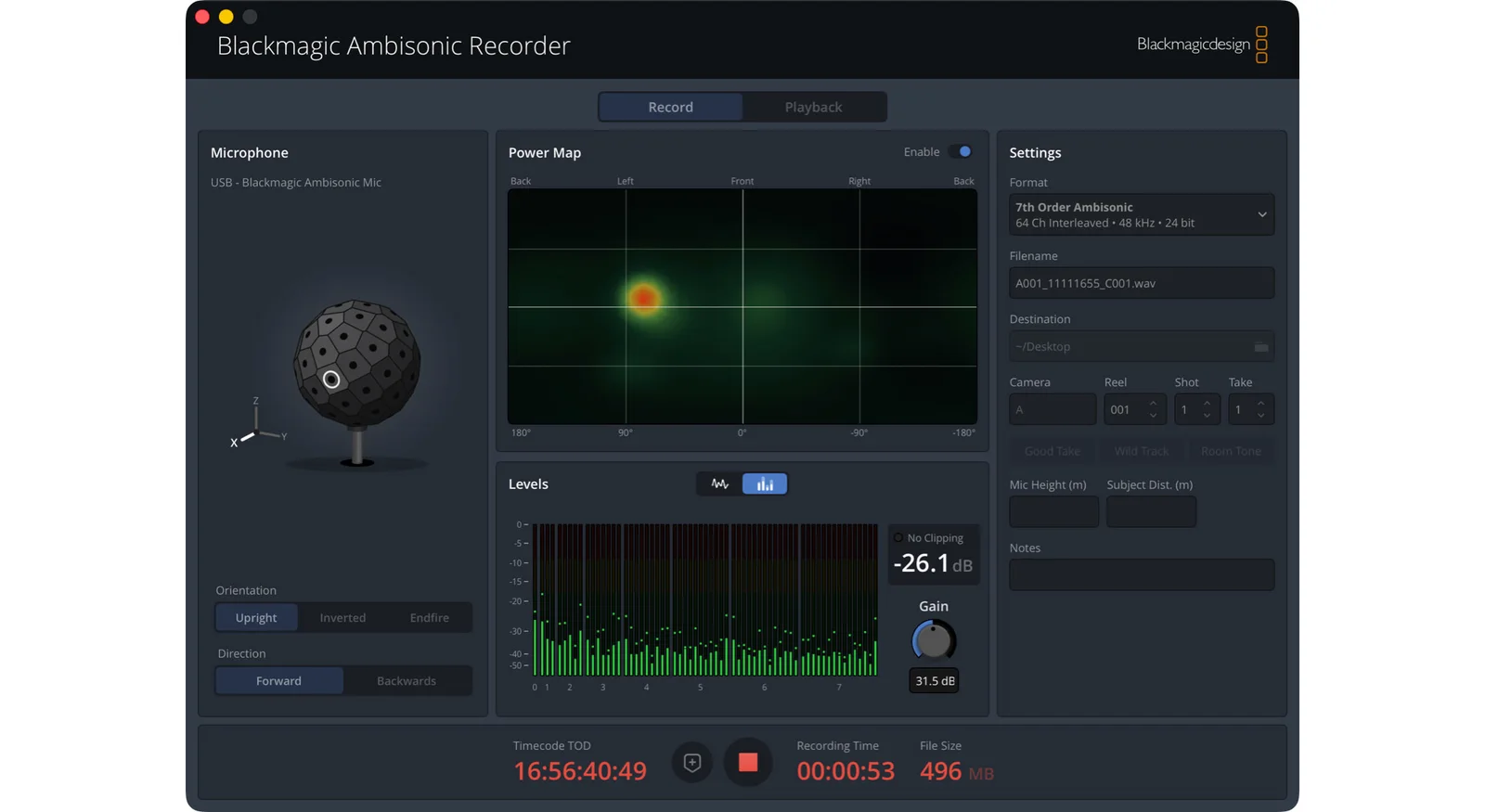
Blackmagic’s press images show the app behind that kind of view, the Blackmagic Ambisonic Recorder, with a Power Map of where the sound comes from, 64-channel level meters with a clipping indicator, gain, and take metadata (camera, reel, shot, take, mic height, subject distance).
Hands-on impressions so far
The only hands-on I’ve found so far is Hugh Hou’s. He tried the mic in person at the event. These are his impressions, not measurements:
- the spatial resolution sounded very close to what he hears with his own ears: direction, distance and height;
- he values the 32-bit audio Blackmagic advertises because he no longer has to worry about clipping;
- it’s about the size of a fist, with a magnetic mic mount and a locking USB-C cable as accessories;
- it can be mounted upright or sideways; mounted sideways it sits further from the camera fan, so it picks up less fan noise. (He guesses there’s a gyro inside; Blackmagic hasn’t said so. Its recorder app does have Upright, Inverted and Endfire orientation settings.)
What we know and what we don’t
| Known | Not known yet |
|---|---|
| 7th order, 64 channels, 108 MEMS capsules | Sample rate options beyond 48 kHz |
| Encoding inside the mic, one USB-C cable for audio and power | Self-noise and frequency response |
| URSA Cine Immersive, Fairlight Live and iPhone recording | Handling noise and wind performance |
| A SMPTE-2110 converter is planned | How it copes with harsh environments |
| Available in December 2026 | When pre-orders open |
One detail to watch: the product page talks about 32-bit audio, while the recordings in Blackmagic’s press images, and its sample file, are 24-bit at 48 kHz. The final spec sheet should clear that up.
How Spadio fits the workflow
Blackmagic’s chain covers capture and the Apple Vision Pro delivery through DaVinci Resolve and Fairlight. But a 7th-order recording usually has to go to more places than that: a director who wants to hear the take, a web page, YouTube, a game engine, a Dolby Atmos session. That’s where Spadio comes in. Two of the Spadio apps now support 7th order, and I tested both with Blackmagic’s own sample and with a plain 64-channel WAV, the format its recorder app shows. Both detected 7th order straight away.
| Moment in the workflow | Spadio app | What it does for you |
|---|---|---|
| Checking takes | Spadio Hub | Open the WAV or CAF in the browser and hear it binaurally on headphones, with head tracking, without opening a DAW session |
| Seeing where the sound is | Spadio Hub | A sound energy heat map, as a glowing sphere and a flat 360° map |
| Web, WebXR and streaming | Ambix Compressor | WAV, RF64 or CAF to Opus Ambisonics (.ogg) at any order from 1st to 7th, about 90% smaller, with a binaural A/B player |
| YouTube 360, game engines | Spadio Hub | Export AmbiX at any order from 1st to 7th |
| Clients, social, podcasts | Spadio Hub | Export binaural 3D, a stereo downmix or a mono sum that plays anywhere |
| Dolby Atmos and DAWs | Spadio Hub | Export an ADM BWF master |
Check a take in a minute: Spadio Hub
Drop the WAV, CAF or Ogg Opus file on Spadio Hub and it reads the 64 channels as 7th-order AmbiX and plays them binaurally, so headphones are enough. Headphones only have two channels, so Hub spreads the 64 Ambisonic channels over 84 evenly spaced virtual speakers around your head and renders each one through a head-related filter. A 7th-order field needs at least 64 speakers to keep all of its detail; a few extra let them sit evenly, so every direction is reproduced equally sharp. Turn on head tracking (your webcam works in the browser) and the sound field stays put as you turn. Switch to Heat map to see where the energy is, much like the Power Map in Blackmagic’s recorder, which is handy for finding the moment that matters in a long recording.
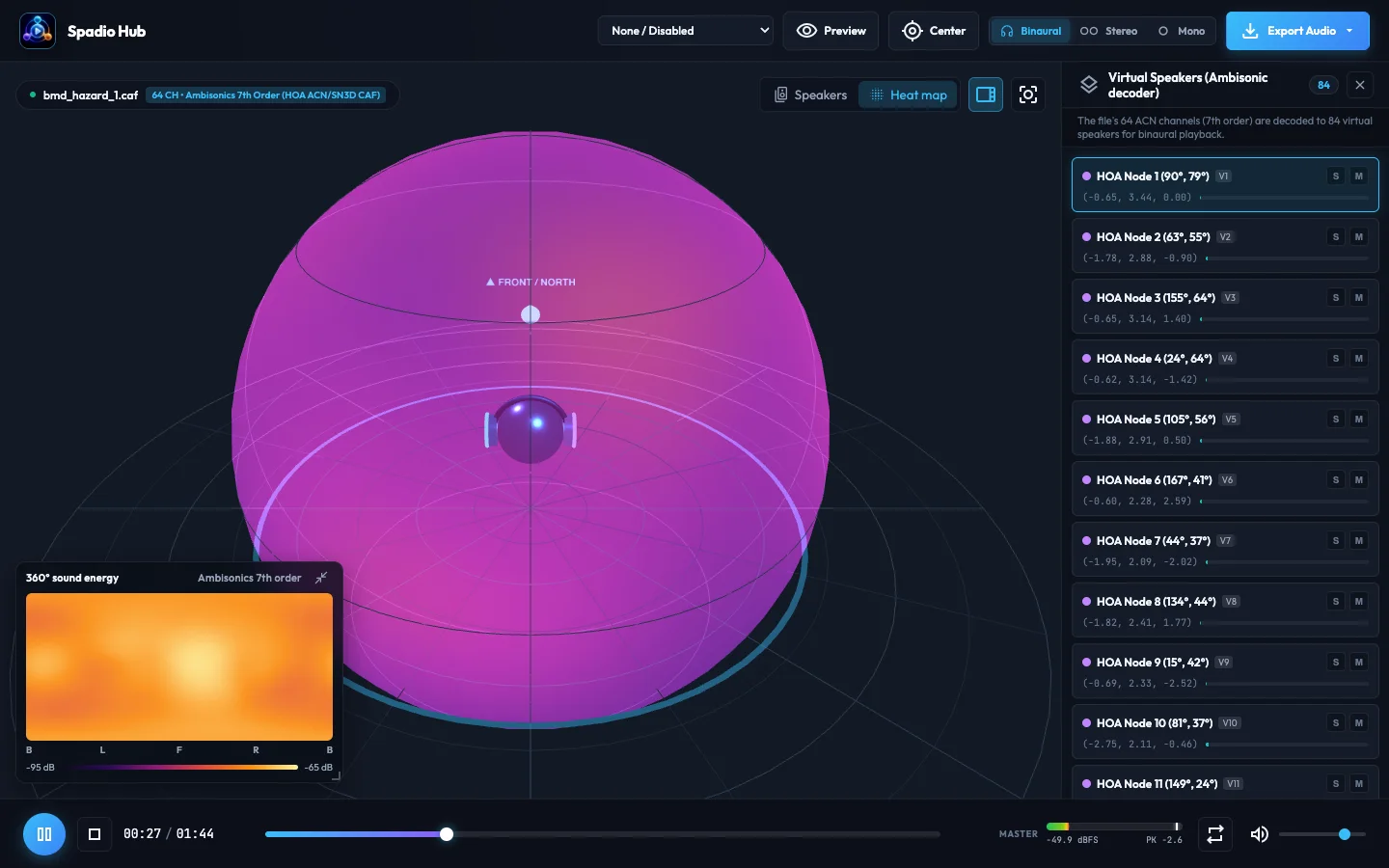
When someone else needs to hear it, export Binaural 3D (HRTF): a normal stereo WAV that sounds spatial on any headphones, no special player needed. From the same export menu you get AmbiX at any order from 1st to 7th, a stereo downmix, a mono sum or a Dolby Atmos ADM BWF master.
Ready for the web: Spadio Ambix Compressor
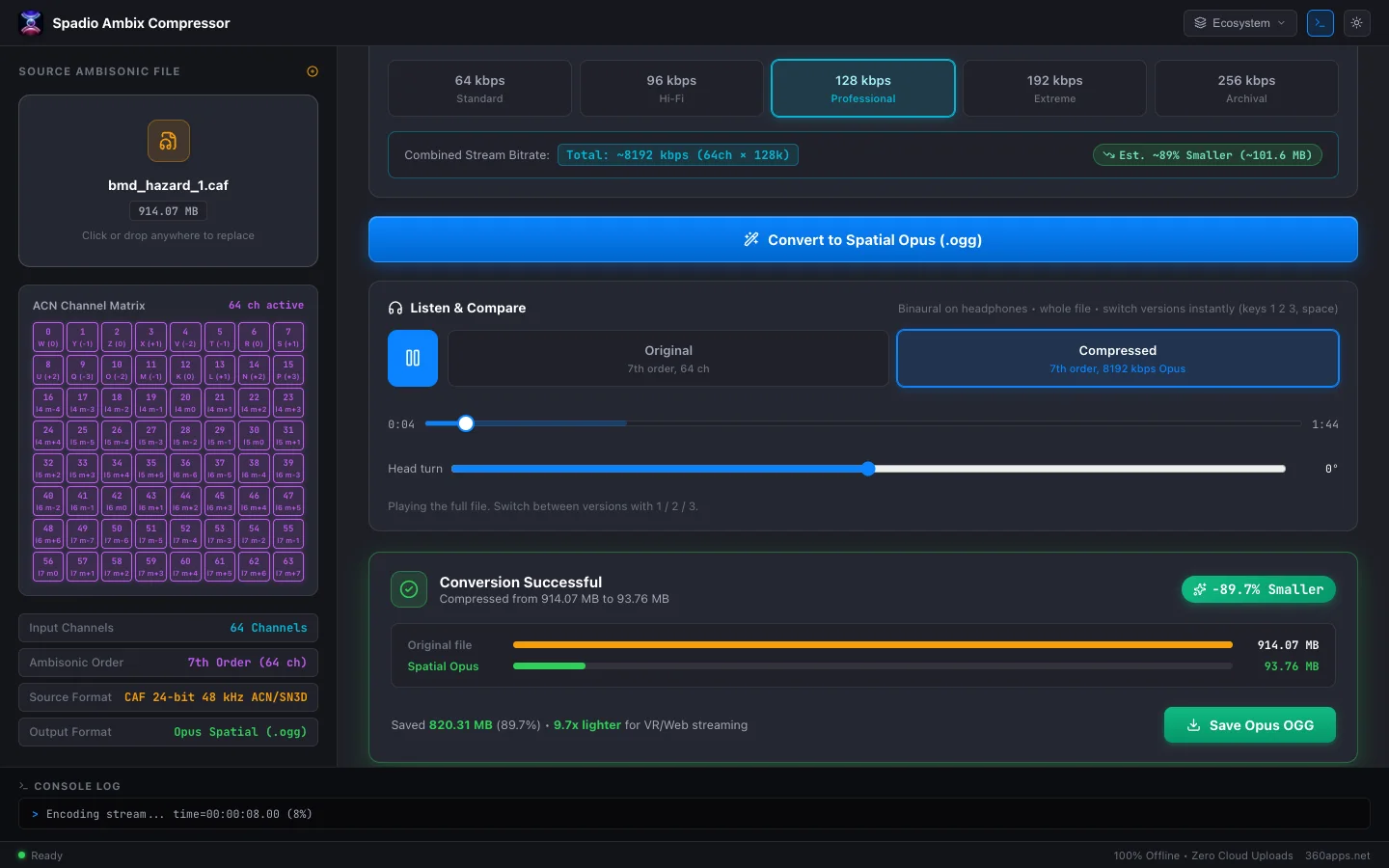
A minute of 7th-order audio is about 550 MB uncompressed, far too heavy for a web page or a headset download. Spadio Ambix Compressor opens AmbiX WAV, RF64 and CAF files up to 7th order and encodes them to Opus Ambisonics (.ogg), keeping all 64 channels or choosing any lower target order down to 1st. With Blackmagic’s full sample at 128 kbps per channel, it made the file 89.7% smaller (958 MB down to about 98 MB) in about half a minute on my Mac, without uploading anything. Then Listen & Compare plays the whole file binaurally on headphones and switches instantly, with the keys 1, 2 and 3, between the original, the original reduced to your target order (uncompressed) and the compressed version. All three are level-matched, and a head-turn slider lets you check the rotation before you save. The result plays straight back in Spadio Hub.
Getting ready before it ships
| Snag | What to do |
|---|---|
| Your player opens the sample but it doesn’t sound 3D | You’re hearing raw channels. Use an Ambisonic player such as Spadio Hub, with headphones. |
| Your audio is inside a BRAW camera file | Export it as a WAV from DaVinci Resolve first; Spadio doesn’t read BRAW. |
| The files are too big to put online | Compress to Opus with Ambix Compressor, or lower the order to 3rd (16 channels). |
| The platform only accepts 1st order (YouTube 360) | Export 1st-order AmbiX from Spadio Hub and put it in the video with spatial audio metadata. |
| Left and right seem swapped | Check the file is AmbiX (ACN/SN3D), as Blackmagic’s files are, not the older FuMa convention. |
Ideas for the first recordings
- A forest or city ambience for a WebXR scene, compressed to Opus for fast loading.
- Concerts and rehearsals, where Hugh Hou expects the in-sync recording to end timecode drift.
- Interviews and behind-the-scenes on iPhone, shared as binaural stereo on social.
- A 360 video with a 1st-order version for YouTube and the full 7th order kept as the archive master.
- Sound libraries delivered at several orders from one recording.
Before you plan around it
The microphone hasn’t shipped yet, so everything about its sound is a promise and a few first impressions, not a review. Dates and specs can still change before December. I’ll update this post when the spec sheet is out and the first independent tests appear. The Spadio parts above I tested myself with Blackmagic’s sample file and a 64-channel WAV.
Questions
When is the Blackmagic Ambisonic Microphone released?
Blackmagic announced it on 11 November 2026 and says it will be available in December 2026 from Blackmagic Design resellers worldwide.
What does Apple have to do with the Blackmagic Ambisonic Microphone?
According to Blackmagic's press release, the mic grew out of its work with Apple on the URSA Cine Immersive camera. Apple licensed its array geometry and ambisonic encoding filters, and Blackmagic did the engineering and design. It's a Blackmagic product, built for Apple Immersive Video workflows.
Does it need a recorder, phantom power or encoding software?
No, according to Blackmagic. The encoding to 7th-order Ambisonics happens inside the microphone, and a single USB-C cable carries both audio and power. It's class compliant, so there are no drivers to install.
Can I use it without the URSA Cine Immersive camera?
Yes. Blackmagic says you can also connect it to a computer and record and mix with Fairlight Live, or record straight to an iPhone with the Blackmagic Camera app. A USB to SMPTE-2110 converter for broadcast is also planned.
What format does it record?
7th-order Ambisonics: 64 channels. Blackmagic's product page mentions 32-bit audio; the recorder screens in its press images show 64-channel interleaved WAV files at 48 kHz and 24-bit, in AmbiX ACN order. Expect the final spec sheet to settle this.
What don't we know yet?
The full specifications: sample rate options, self-noise, handling noise, wind performance, how it copes with harsh conditions, and the exact pre-order date.
Can I work with 7th-order files before the mic ships?
Yes. Blackmagic's product page has a 7th-order sample file. Spadio Hub opens it in the browser and plays it binaurally on headphones, and Spadio Ambix Compressor makes it about 90% smaller as Opus for the web.
Sources
- Blackmagic Design Announces Blackmagic Ambisonic Microphone, Blackmagic Design press release, 11 November 2026 (also the source of the press images)
- Blackmagic Ambisonic, Blackmagic Design product page (availability, sample file)
- Hugh Hou, “Blackmagic Ambisonic Microphone: 108 Mics, 7th Order Spatial Audio for Apple Immersive”, YouTube, 12 November 2026 (stage demo and hands-on impressions)